

Co-Creation Webinar #2 : Together for Girls in ICT – Transforming Ideas into Practice

The second co-creation webinar of the pICTureURpath project took place online on 7 May 2026 under the title “Together for Girls in ICT: Transforming Ideas into Practice.” Building on the findings and discussions of the first webinar, the event brought together educators, researchers, ICT professionals, policymakers, parents, and other stakeholders to collaboratively explore practical actions that can support girls’ participation in Information and Communication Technologies (ICT).
From Evidence to Action
The webinar began with a presentation of key findings from the project’s research activities, focusing on the factors and stereotypes that influence girls’ educational and career choices in ICT. Through a series of infographics and an interactive poll , participants reflected on the perceptions of different stakeholder groups and the challenges that continue to limit girls’ engagement with technology-related studies and professions.
A brief overview of the results from the first co-creation webinar was also presented, providing the basis for a more action-oriented discussion aimed at transforming identified challenges into concrete solutions.
Collaborative Discussions and Exchange of Practices
Participants worked in breakout groups to discuss successful practices, persistent barriers, and opportunities for intervention. Several key themes emerged across the discussions.
Each group worked under a specific thematic area. The thematic areas were as follows:
1.What training do teachers need to overcome gender bias in the classroom?
2.What kind of experiential learning do students need in order to reduce the gender gap in ICT?
3.How can schools build partnerships with NGOs and companies? What could these partnerships contribute to gender equality in ICT?
4.How can female ICT role models be promoted to inspire young girls?
5.How can families support gender equality in ICT?
6.What curriculum reforms are needed in educational materials?
Here you can see some of the participants’ responses during the breakout rooms
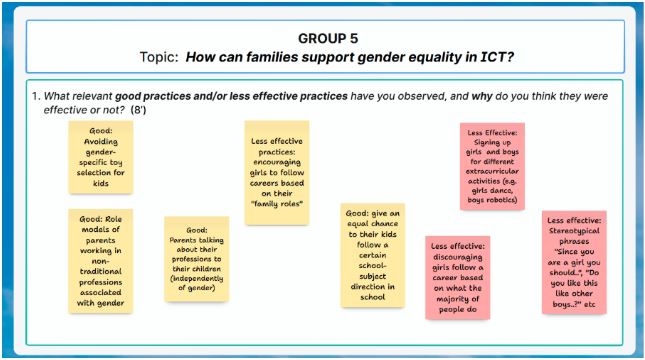
Participants highlighted strengthening collaboration between schools, ICT professionals, companies and civil society through mentoring, school visits, scholarships and partnerships. They emphasized experiential learning such as robotics, STEM activities and gamification to make technology more engaging for students. Female ICT professionals were identified as important role models, with a need for greater visibility through school events and mentoring. Families were also recognized as key actors in challenging gender stereotypes and supporting equal opportunities and diverse career choices from an early age.
Co-Creating Practical Interventions
During the second breakout session, participants worked, under the same topics, on designing concrete interventions that could contribute to reducing the gender gap in ICT.
Each group worked under a specific thematic area through the previous questions . The thematic areas were as follows:
- Who: What is the main target group?
- Why: What is the measurable goal(s) of the intervention?
- What: What is the content of the intervention?
- Where: Where will it take place (classroom, school, online, external setting)?
- When: What is the duration, and how does it relate to the curriculum?
- How: What methods, activities, and supporting materials will be used?
- Expected outcomes: What results do you expect in terms of knowledge, attitudes, or behaviour change?
Here you can see some of the participants’ responses during the breakout rooms
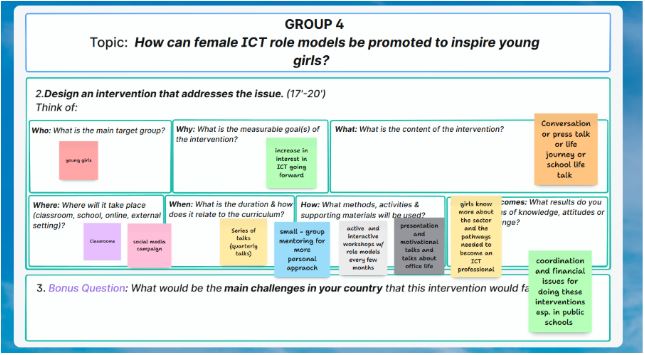
Among the proposed ideas were:
- Training programmes and toolkits to help teachers recognise and address gender bias in the classroom.
- Regular talks, workshops, and mentoring activities involving female ICT professionals to inspire young girls and increase awareness of ICT career pathways.
- A STEAM-based competition model, where students collaborate to solve real-world challenges with the support of professional mentors, combining technological, creative, and social skills.
Participants also discussed potential implementation challenges, including limited resources, school time constraints, coordination requirements, and cultural barriers that may affect participation in different national contexts.
Key Takeaways
Across all discussions, several common priorities emerged:
- Promoting female role models in ICT.
- Expanding mentoring opportunities for girls.
- Strengthening partnerships between schools, industry, NGOs, and communities.
- Encouraging experiential and project-based learning approaches.
- Supporting families in challenging gender stereotypes and fostering equal opportunities.
Looking Ahead
The results of the webinar and workshops will feed into the project’s co-creation workshops report and inform the development of the policy framework on gender equality in ICT education and careers. Following the co-creation phase, the piloting phase will begin and will run throughout the 2026–2027 academic year, implementing and testing the developed interventions in practice.
How to get involved further
Interested individuals are invited to:
- Explore the gender dimension in ICT in Europe through the project’s English infographics.
- Join the project’s Community of Practice (CoP).
The project continues its commitment to promoting open dialogue and strengthening gender equality in ICT education and career development.